
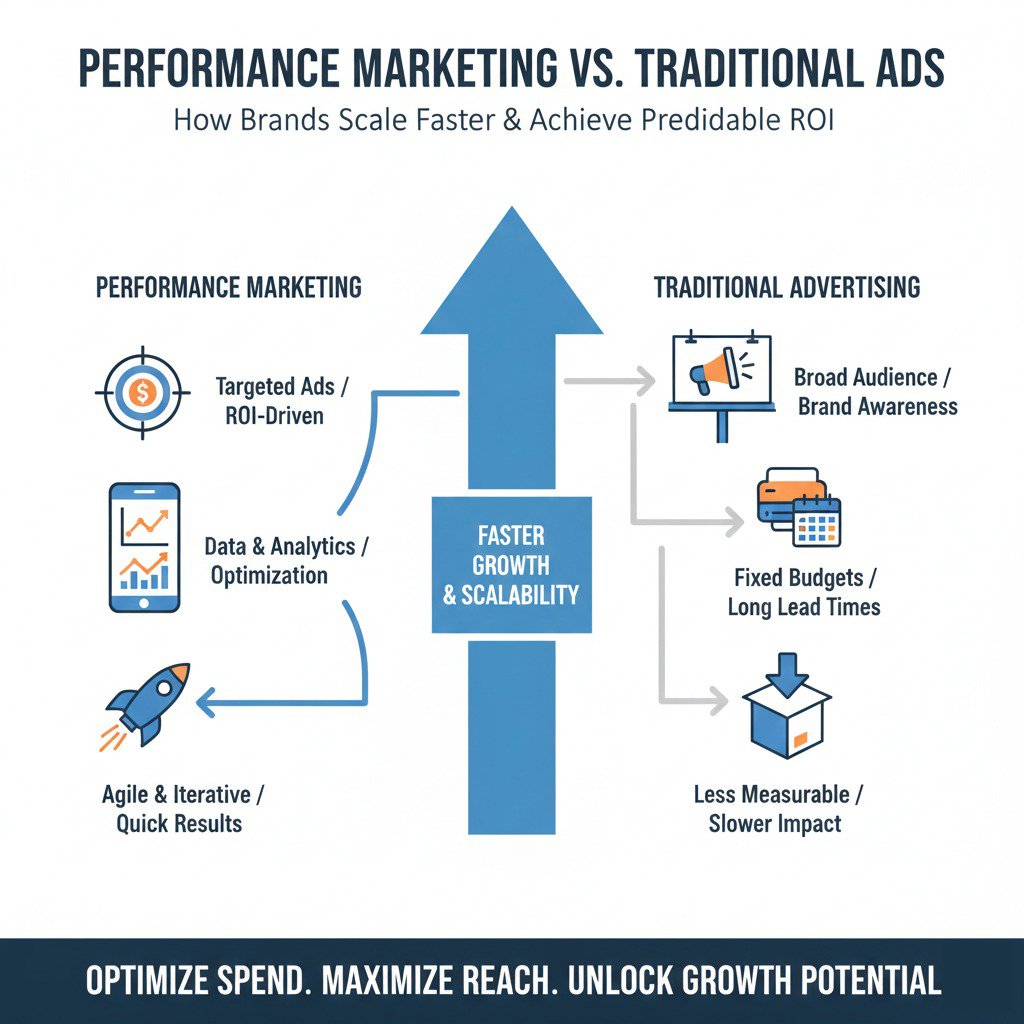
The aim of all businesses, regardless of size, is to scale their brands to be rapid and sustainable, due to today’s hyper-competitive digital landscape. The biggest challenge continues to be how to find marketing strategies that provide not only visibility but also quantifiable return on investment (ROI). Although traditional advertising certainly has its advantages, it typically lacks the speed and data-supported effectiveness that performance marketing can provide.
Digital Fruits is dedicated to providing our partners with measurable outcomes and the ability to grow their brand at an accelerated pace. This is why we always advocate for performance marketing as the optimal avenue for growth, as it emphasizes actionable, trackable results, rather than simply impressions.
A Major Transition: From Impressions to Actions
Traditional media advertising, such as TV, radio, print newspapers and magazines, and outdoor billboards, was based on impressions (Cost Per Thousand Impressions, or CPM). The objective was to create widespread awareness of a brand in order to drive people to become customers at some point in time due to exposure of their advertisement to a large audience. Therefore, while this strategy creates brand equity over time and grows the value of a company’s brand, determining how much of that growth was due to the impression and whether there is a return on investment can be challenging at best.
Conversely, performance marketing operates under a results-driven premise. Companies only pay when a specific agreed-upon action is taken. Examples of these actions include generating leads, completing sales transactions, downloading an app, or clicking on a link to go to a website. This fundamental shift in thinking means that any marketing dollar spent by a company will be tied directly to the final outcome of the transaction and makes this a more efficient and scalable model.
Key Pillars That Drive Faster Scaling
The foundation of performance marketing’s ability to scale brands at an accelerated rate is built around several core principles:
1. Data-Driven Precision and Optimization
Performance marketing is ultimately a function of data; it consists of many platforms that generate large amounts of real-time data on customer behavior through every campaign (Google Ads, social media ads, and affiliate marketing).
- Granular Targeting: Performance marketing platforms provide marketers with the ability to hyper-segment their audiences based on countless criteria, including demographic information, customer interest, customer behaviors, and previous interactions with brands, allowing them to connect with the most receptive audience.
- A/B Testing & Iteration: Through A/B testing, marketers are continually able to test variations in creative, headlines, landing pages, and call-to-action messaging to find which resonates most with their audience.
- Rapid Optimization: Performance marketing data provides marketers with the insights to immediately make changes to underperforming ad creative, headlines, and landing pages and scale the ads that provide the greatest returns. Performance marketers have the ability to continually optimize campaigns as new data emerges, resulting in campaigns that are smarter and more effective after every dollar spent, and therefore shorter time-to-result.
2. Cost Efficiency and Highest ROI
The pay-per-performance model has significantly less risk compared with traditional pay-per-click (PPC) campaigns by increasing the predictability of a company’s finances.
- Controlled Spend: Companies will only be billed for verified actions, thus avoiding wasteful spending on consumers who had no interest in the product or service being advertised. This element is especially important for companies planning to expand, as controlled spending provides accurate forecasting and consistency in budget development.
- The Ability to Calculate Clear ROI: Since every action taken by a customer is tracked, companies can calculate return on advertisement spend (ROA). This clarity allows companies to feel confident in their decision to increase their advertising investments in channels that yield return-on-investment (ROI), thus allowing for rapid growth.
- Start-Up Low Barrier to Entry: Smaller companies are able to compete effectively in the marketplace by utilizing a lower starting budget that allows the company to grow as long as there is evidence of positive results.
3. Agility and Flexibility
Performance marketing provides incredible flexibility due to its digital nature.
- Real-time Campaign Adjustments: Market shifts, competitor moves, or changing consumer preferences can be addressed instantly. Campaigns can be modified, paused, or redirected with a few clicks, preventing prolonged periods of inefficient spending.
- A variety of channels: Performance marketing employs a variety of channels and delivery methods, including SEM, social media advertising, display advertising, native advertising, affiliate marketing, etc. This flexibility allows companies to quickly shift to the channels and methods that are most effective for achieving their growth objectives.
Conclusion: The obvious path forward in marketing strategy if you want to grow and sustain a business.
If your business needs to grow quickly and sustain itself, that means your business will need performance marketing. Performance marketing allows companies to measure their activities based on actions and optimize those activities over time using data, while providing a level of agility that traditional advertising cannot provide.
As a Digital Fruits partner, you work with us to build, implement, and scale your performance marketing strategy into accelerated growth through investing in your business digitally. You will use performance marketing to future-ready your brand and stay ahead of the competition.
FAQs
Q1. What is performance marketing?
This is a method of digital marketing that allows companies to only pay for actions taken by a consumer (i.e., sale, lead, click).
Q2. How is performance marketing compared to traditional advertising (i.e., TV)?
Performance marketing is generally more measurable than traditional advertising (and also more focused on return on investment). You pay for specific results, rather than general advertising exposure (impressions).
Q3. What is Return on Ad Spend (ROAS)?
ROAS (Return on Ad Spend), a performance measurement for advertising spends, explains how much revenue you generate with each dollar spent on advertising.
Q4. What Types of Channels Are Used within Performance Marketing?
Common performance marketing channels include search engine marketing (SEM), paid social media ads, display ads, and affiliate marketing.
Q5. Can small businesses use performance marketing for their business?
Yes, and yes again. Because of its pay-for-performance and data-driven characteristics, performance marketing will be an extremely efficient budget option for small businesses and brands—it is very scalable!
Leave a Reply