
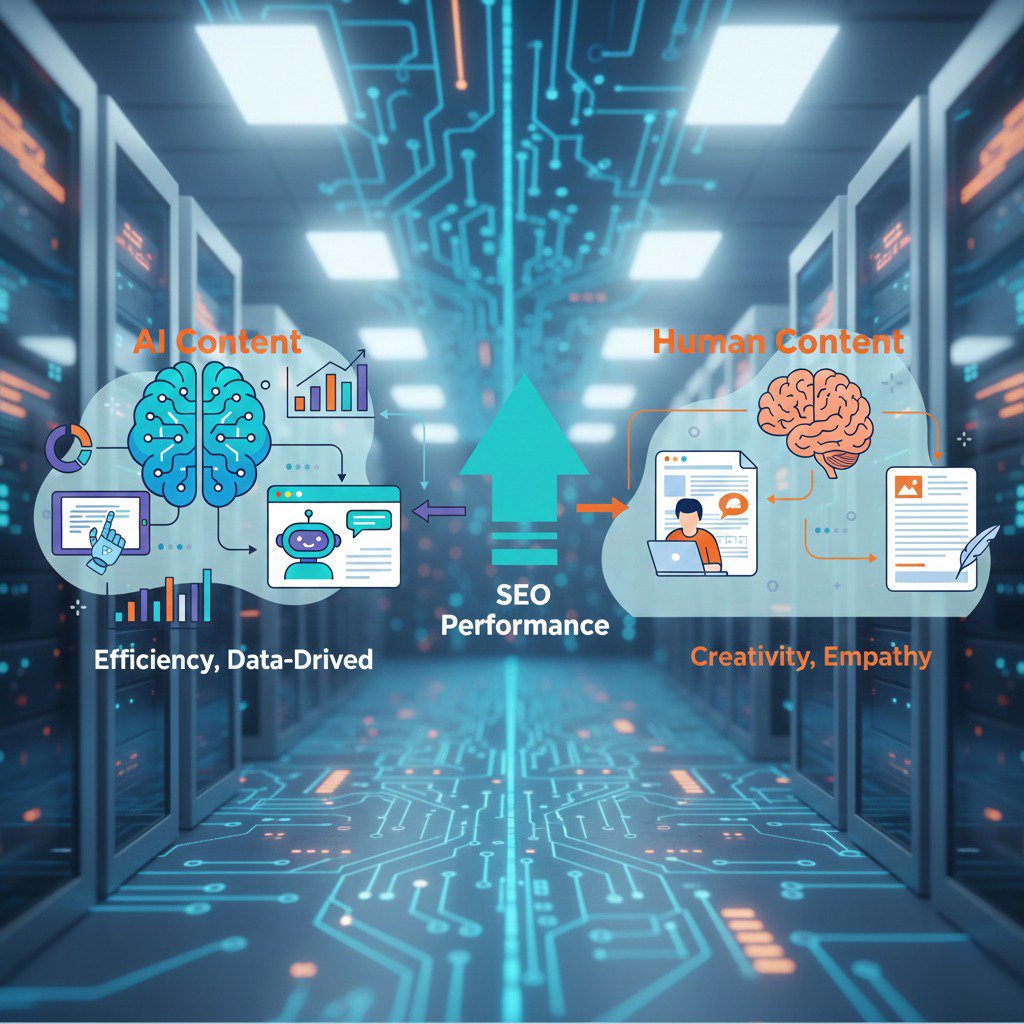
AI cannot replace human content creators. The SEO approach in 2026 will not be AI content vs. human content but the combined efforts of AI content with the human creator’s efforts. Google has made its position clear: It will reward content that is valuable and helpful regardless of whether it is produced by AI or human efforts. However, Google also places high importance on the “4 E’s” of content quality: E-E-A-T (Experience, Expertise, Authoritativeness & Trustworthiness). Only by having a real human involved can these “4 E’s” be fully realized and achieved.
High-quality content produced using a hybrid strategy between AI and human creators will dominate the field of SEO in the future.
1. The Critical Difference Factor: Experience (the first E of E-E-A-T)
While AI models can analyze and process large amounts of existing information to create useful content for many topics (expertise and authoritativeness), they lack the personal experiences of real-life people when it comes to producing high-quality content. This is especially critical in YMYL (Your Money or Your Life) sectors such as finance, health, and technical reviews.
| Content Type | AI's Role (Speed & Scale) | Human's Role (Depth & Trust) |
|---|---|---|
| YMYL / Review Content | Fact-checking, structuring, and generating a basic outline. | Providing first-hand experience, original images/data, and genuine opinion. |
| Technical Guides | Code snippet generation and summarizing documentation. | Validating code, adding context, and sharing real implementation challenges. |
| Evergreen Content Hubs | Rapid drafting of sections and identifying related entities. | Injecting unique insights, brand voice, and strong E-E-A-T signals. |
Fact-checking, structuring, and generating a basic outline.
Providing first-hand experience, original images/data, and genuine opinion.
Code snippet generation and summarizing documentation.
Validating code, adding context, and sharing real implementation challenges.
Rapid drafting of sections and identifying related entities.
Injecting unique insights, brand voice, and strong E-E-A-T signals.
The Mandate: Use AI to cover the what and how-to-basic, but use human experience to provide the why and how-to-expert.
2. How To Avoid The Content Trap—Generic & Repetitive
The most dangerous part of relying on AI to create content is that it will produce an abundance of low-quality and generic content. Because AI is trained on billions of documents from the internet, the outcome will be:
- Semantic Drift: While AI can produce content that appears correct, the output will not have the semantic density required to qualify as a “Source of Truth” in the context of AI Search (SGE).
- Robotic Tone: Because of the lack of a unique brand voice, emotional depth, or direct perspective, it will be much easier for human readers to determine which websites qualify as authoritative.
- Increased Risk of Hallucinations: AI-generated content may have fictitious facts, references, or credit, which diminishes the overall Trustworthiness (T) signal of the content.
To avoid these issues, every draft created by AI should be reviewed by a human in a Human Enrichment Pass (HEP). This means:
- Fact Checking: All statistics, facts, and references should be checked against reliable sources.
- Injecting a Voice: The introduction and conclusion should be rewritten, and original examples, analogies, or experiences should be included.
- Adding Value: The article must include deeper analysis than what currently appears within the top 3 organic search results on the SERP.
3. Strategy for 2026: The Symbiotic Workflow
Digital Fruits is leveraging artificial intelligence to create a symbiotic content development workcast. As demonstrated in the figure above, we look to use AI to supplement human strategists in a content workflow where AI focuses on the research function (topic cluster analysis & user intent mapping) and human strategists focus on the content development/review process.
- Using AI to Conduct Research and Prepare User Intent Maps: This is how we will identify related topics and predict intent for users based on their search patterns.
- Using a Human Strategist to Create Content Outlines & Prompts: The strategist’s job is to give the AI engine the best opportunity for producing a first draft of high quality. They will create a detailed outline and prompt for the AI so that the E-E-A-T structure can be incorporated into the first draft and subsequently the final draft.
- Using AI to Create the First Draft: AI creates the base draft for the Human Enrichment & Verification process. This is where the speed and structure provided by the AI engine become apparent.
- Human Enrichment & Verification: The HEP process includes editing, verifying, enriching with real-world examples, and adding author credentials to the base draft. In addition, structured data (schema) is incorporated for generative engine optimization (GEO).
The Future of SEO—A New Approach to AI Content Development
While there may be some concern regarding how much the use of AI tools will impact the future of search engine optimization (SEO) by hiding AI tools, the future of SEO will most likely have much to do with the transparency of the hybrid approach being developed by Digital Fruits and the quality control provided through our human strategist and human verification processes. Ultimately, the best approach is to create high-quality content that is technically proficient and authoritative/trustworthy so that it can be cited by AI Overviews and be trusted by our audiences.
FAQs
Question 1) Are Google penalties in place for AI-created content?
Google’s algorithm will evaluate content based on quality, not the originally created method. Content that is not a verified original and low-proof will most likely rank low.
Question 2) What does “hybrid content model” mean?
The hybrid content model is an SEO strategy that incorporates the speed and scalability of AI-created drafts and combines them with the fact-checking, unique insight, and E-E-A-T of experts to produce quality content.
Question 3) What element does AI lack from the E-E-A-T elements?
Experience is the missing part of the E-E-A-T equation. AI can create content based on it synthesizing existing information but cannot provide original or firsthand information, case studies, or unique data.
Question 4) What is the Human Enrichment Pass?
The Human Enrichment Pass is the process by which an editor reviews, fact-checks, and validates the data from the AI-generated draft and then adds their own human voice and elements that would give the reader more value.
Question 5) What are the appropriate applications for AI to use in creating content?
Use AI to research, create outlines, draft the rudimentary text of the content, and create clusters of semantically related text, while utilizing the time and knowledge of a human to direct the writing and ultimately approve the final product.


Leave a Reply