
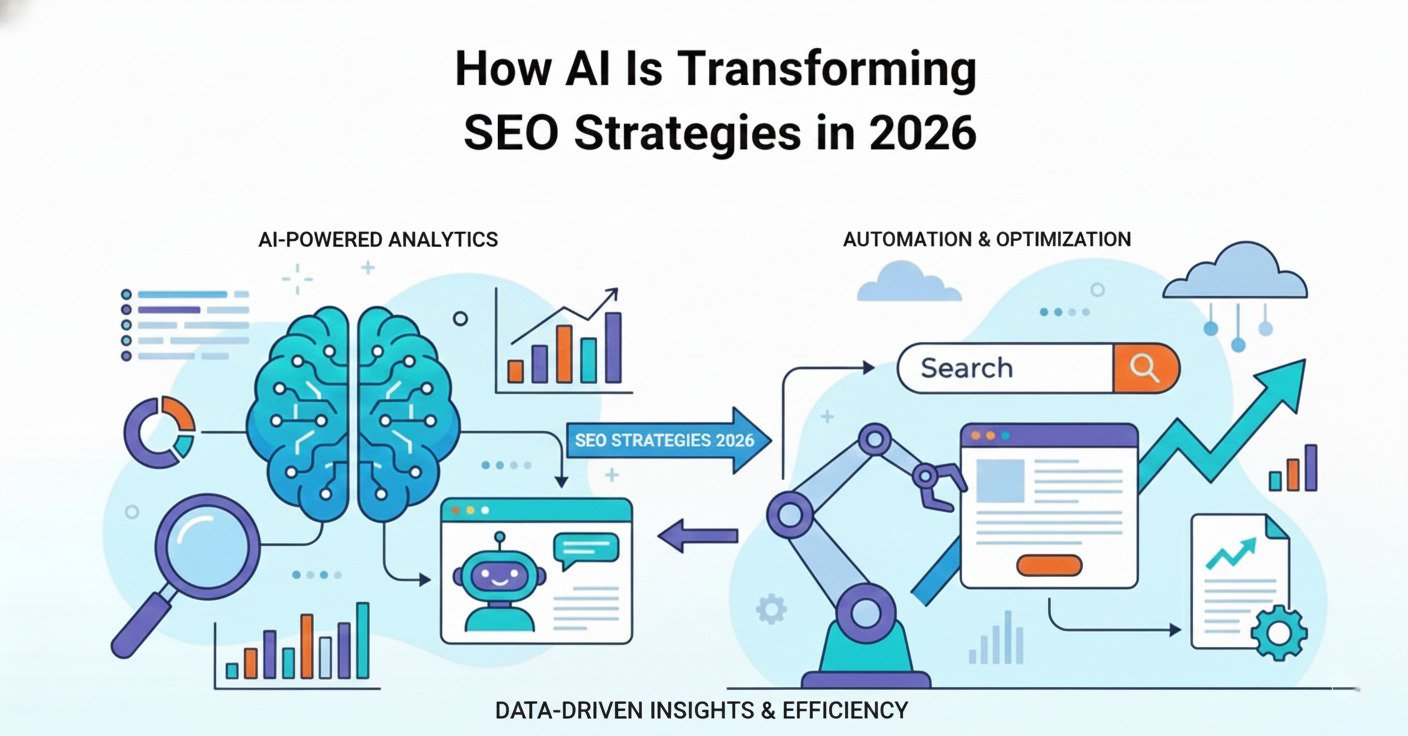
The search engine realm will ultimately evolve from one based solely on keywords and backlinks to one being influenced by AI-driven technology by the year 2026 through programs such as Google’s Search Generative Experience (SGE), Gemini, and numerous other Large Language Models (LLMs). Once completed, this evolution establishes a new direction for Search Engine Optimization (SEO), focusing on Generative Engine Optimization (GEO) instead.
To accommodate this shift, Digital Fruits must ensure that all optimized content becomes the recognized authoritative source for all queries made via artificial intelligence-generated summaries, as opposed to merely appearing amongst the top search results.
There are two fundamental components associated with this transition:
1. Core Transition: A shift from keyword-driven content to intent-driven content and entity-driven content.
AI has reached the level of Artificial Intelligence Natural Language Processing (NLP) such that it can now not only identify the keywords in a query but also understand the intent behind the query as well as the underlying context.
- Intent-Driven Optimization—In order to be successful as an SEO entity in 2026 or beyond, businesses will be required to focus more on fulfilling user intent through the answers provided in their content as opposed to simply focusing on keyword density.
- Entity-Based SEO—Similar to the manner in which humans have developed the ability to connect related pieces of information based on entities (for example, person, place, product, concept, etc.), so too have AI technologies. Thus, businesses will be required to establish their level of topical authority within their industry by means of a content cluster approach in defining and describing all entities associated with their particular field(s). By doing this, businesses will provide AI systems with a clearer understanding of their area of expertise and therefore create a greater opportunity for success.
- Actionable Step: Leverage AI-powered tools to group related keywords into comprehensive topic clusters rather than optimizing pages for single terms.
2. The New Metric: Generative Engine Optimization (GEO)
AI is more frequently and prominently displaying sources as outputs of searching. This trend is leading to the growth of “zero-click searches.” Therefore, your priority as an author should shift from getting a “click” to obtaining a citation.
Generative Engine Optimization (GEO) is the process of writing content with such structure that AI models readily and easily identify it as authoritative and can cite it in their outputs.
- Structure Your Content to Provide Immediate Answers to Queries (AEO): You want your readers to get answers they need immediately. This means you will need to write your content in such a way that you are following the inverted pyramid model, where you will first give your readers the answer to the question they have and then provide supporting details and evidence
- Use Schema Markup as Fuel for Your AI Efforts: One aspect of optimizing your content for AI is to provide rich snippets and machine-readable schema markup for FAQs, how-tos, products, and reviews. Schema markup serves as a layer of context that allows AI models to easily and quickly determine the quality and intent of your content.
3. Key for Trust: The "E-e-a-t" Principle & Transparency
As a result of the vast amount of AI-created content available today, the “E-e-a-t” principle is increasingly being used as a filter to determine which content is credible. The model will train to promote or demote content based on its credibility; therefore, it must be credible, verifiable, and based on actual experience.
- Because of this, you need to define your experience; create detailed author bios with concrete examples, as well as case studies, proprietary data, & original research to demonstrate your true industry experience.
- You need to ensure that you verify everything you publish via quality sources! When writing technical information, be sure to link your content to reliable sources such as government and academic institutions and/or peer-reviewed research articles. This will enhance the trust signal for your content.
- Lastly, when you are utilizing generative AI, you must have an editor (human) spend time to validate the integrity of your content and ensure it aligns with your established brand voice and verified claims.
4. Automating Technical SEO and Artificial Intelligence's Force Multiplier
The evolution of the content strategy will evolve; however, the technical foundation will still be very important. AI’s technical capabilities favor websites that load quickly, are secure, and can be crawled easily.
- Hyper-automation: therefore, through the use of AI, we are now automating repetitive and duration-intensive technical activities, which frees human strategists to concentrate on E-E-A-T and GEO. An example of this includes automated:
- Monitoring of Core Web Vitals and flagging issues.
- Schema generation for complex product or service pages.
- Competitor analysis to find content gap analysis and cluster of intent.
- Multimodal Optimization: There has been significant growth in the use of voice and visual searches, which can now be done through AI. Increasingly, we now need to optimize all content for voice search queries and not simply text, plus optimize text through image captions, video transcripts, and spoken questions.
Digital Fruits: Navigating the AI-First Future
Digital Fruits is an agency that believes that navigating through the world of AI will be a big challenge for all SEO practitioners. We at Digital Fruits do not see this transformation to AI as a threat; instead, we view this as the strategic development of SEO. Digital Fruits will incorporate the new advanced techniques of GEO and AEO into every SEO strategy for every client to position itself as the leading source for AI-driven search results in 2026.
Now is the time to make the shift from reactive to predictive SEO by planning ahead for future user intent and content supply/demand before they become mainstream.
FAQs
Q1. What does AI-first search mean?
In AI-first search, generative AI-based tools such as LLMs are used to generate and directly provide answers rather than simply providing search results (links).
Q2. What do you mean by Generative Engine Optimization (GEO)?
GEO is a strategy for creating content that will be trusted (i.e., selected and cited) by AI systems when generating answers.
Q3. In what ways does AEO differ from SEO?
In answer engine optimization (AEO), sites structure their content so that people can quickly find, see, and verify an answer. Traditional search engine optimization (SEO) focuses primarily on keyword position.
Q4. What is the most essential part of an AI-first SEO strategy?
The foundation of any successful AI-first SEO strategy must include E-E-A-T (Expertise, Experience, Authority, and Trust). These qualities are the primary criteria by which AI selects content from which to generate answers.
Q5. Will there be no more organic backlinks by 2026?
Organic backlinks will continue to be an option for commercial and transactional terms, but AI-generated summary answers will be increasingly used for both informational and navigational searches.



Leave a Reply