
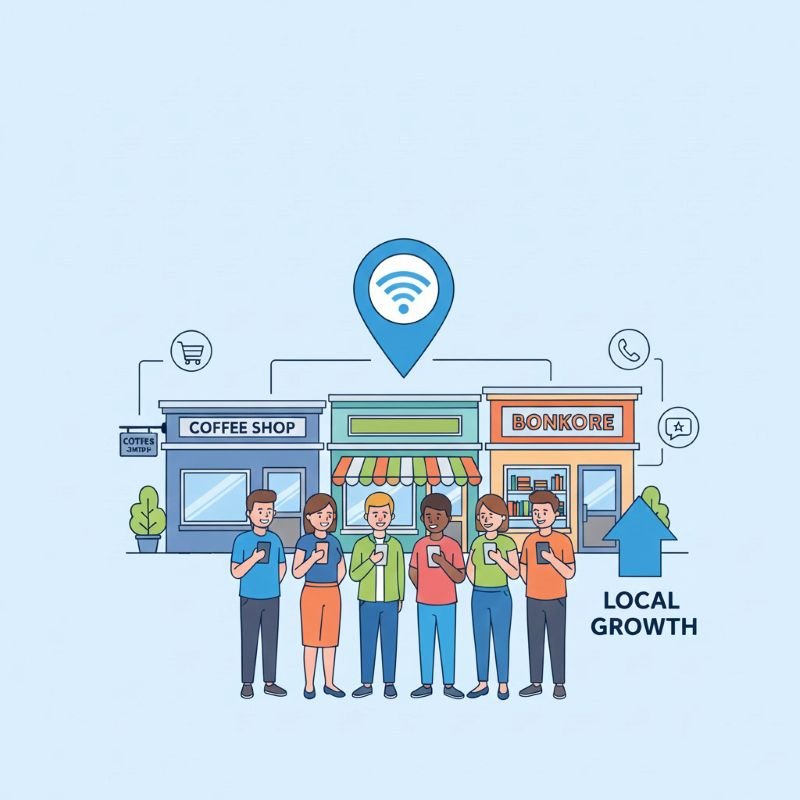
Hyperlocal marketing has established itself as the most effective way for local business owners (LB) to develop meaningful relationships with their targeted potential customers. It eliminates the wasteful use of traditional forms of advertising (e.g., Yellow Pages, advertising circulars, etc.) through targeted messaging delivered through multiple channels directly to consumers in their immediate vicinity. The data consistently shows that it drives measurable ROI for LB owners of all sizes in a highly competitive environment.
Hyperlocal marketing is not just a passing fad but rather will become the primary means for driving repeat business from loyal local customers. By establishing a meaningful relationship with nearby customers, hyperlocal marketing will give more small and medium-sized enterprises (SMEs) the ability to compete with giant global corporations and win in their own backyards.
Shifting Focus From Broadly Targeting Consumers to Hyper-Local Targeting
Mobile technology has changed how consumers behave. The latest research shows that a large percentage of the time, when consumers are looking for local service providers/restaurants/stores, they are utilizing their smartphones and searching using the term “near me” because they are looking for local businesses in their area they intend to buy from or visit right away.
When you run a broadly targeted digital advertisement in a city, it often dilutes the effectiveness of your ad spend, as many users reached by your general citywide advertisement are likely not your ideal customers.
With hyper-local marketing you’re focusing your advertisement spend on a very small radius (often only a few hundred feet/a single neighborhood) where your ideal customer resides, works, or currently is located; this increases the relevance of your advertisement and decreases the number of wasted impressions, which in turn considerably decreases your Cost Per Acquisition (CPA) and increases the number of conversions you receive from your digital advertising efforts.
The Three Pillars of an Effective Hyperlocal Strategy
To transition from generic local marketing to a results-driven hyperlocal approach, businesses must prioritize three key digital pillars:
1. Google My Business (GMB) Optimization & Local SEO
The first pillar of an effective hyperlocal digital marketing strategy is to create a Google My Business (GMB) profile and local search engine optimization (SEO). Your GMB profile is the business’ online representation, and it is often the first interaction with a customer searching for “near me” results. A successful hyperlocal digital marketing strategy begins here with
- Your GMB profile should contain all the correct and up-to-date information regarding hours of operation, telephone number, address, and service area.
- You must actively engage with customers by quickly responding to any reviews and taking advantage of the Posts feature to post updates about your business, including promotional offers and events, in your local area.
- You should naturally include geo-specific keywords in the GMB profile description and list of services.
When your company has optimized the GMB profile and implemented local SEO, you will rank in the top three listings within the Local Pack results, which results in the highest number of click-throughs to your website or business location.
2. Ads Geographically Targeted
Hyperlocal ads utilize technology such as geofencing and radius targets and target users in a local area rather than a citywide target. For example, a coffee shop may use a geofencing advertising campaign to target individuals in a rival coffee shop or office building around a busy time of day. This allows advertisers to utilize their budgets more effectively by only serving ads to those individuals who are currently in an area and are likely to be inclined based on the time of day to patronize their stores. They use performance information to increase foot traffic immediately and to track direct attribution to the advertising campaigns.
3. Localized Content and Localized Social Signals
Digital Fruits utilizes local culture and events as a way to create resonant content. To be successful in hyperlocal marketing, businesses need to create content that addresses the needs of the hyperlocal area. For example, a business may create landing pages specific to an area, e.g., the Best HVAC Repair in [South End], and use them to increase traffic from outside of that area to increase the likelihood of direct referrals from local customers. Social proof can also be developed on platforms such as Instagram and Facebook by showcasing local customer interactions and promotions specific to your business and by using local hashtags and geotags to establish strong, localized social signals.
Measurable results enable:
The Digital Fruits approach utilizes data to drive marketing decisions through hyperlocalization, allowing us to maximize measurable results. The methods employed by hyperlocalization allow us to be able to measure our advertising dollars and identify where converted customers came from.
The cycle of continuous optimization, achievable through hyperlocalization, provides sustainable growth, improved retention rates, and higher ROI compared to those achieved through traditional methods of marketing.
Hyperlocal marketing focuses on finding the right customers, at the right time and location, for a business. This means that any business can take advantage of this method and gain access to the true potential of their local business for growth by embracing it now.
FAQs
Q1. What exactly does the term “hyperlocal marketing” mean?
It refers to a targeted marketing method for a very narrow or limited geographic location (or area), and it typically utilizes methods such as geo-fencing and radius marketing to acquire customers in a specified area or region.
Q2. How does hyperlocal marketing differ from local SEO?
The primary distinction between the two strategies lies in the scope. Local SEO is an effort to optimize for search engines at the city/town level, whereas hyperlocal marketing is geared toward targeting customers in the immediate vicinity (by neighborhood or several hundred meters away).
Q3. What does the term “geofencing” mean?
Geofencing is a method of utilizing GPS technology to create a virtual “fence” around a given geographic area so that businesses can develop an advertising strategy based on reaching out to customers when they are within the area defined by the geofence.
Q4. Is hyperlocal marketing effective for every type of business?
Yes, any type of business that depends on the foot traffic model can benefit from hyperlocal marketing, including restaurants, retailers, gyms, etc., as well as service-based businesses (plumbers, hair salons, etc.).
Q5. How do I capture the ROI for hyperlocal marketing?
The ROI for hyperlocal marketing is based on tracking the growth of foot traffic originating from ads, measuring the redemption of coupons provided in the advertisement, and tracking conversion rates from activating geo-targeted ads.

![Read more about the article Sendinblue vs. Mailchimp: Which is best? [2023]](https://digitalfruits.in/wp-content/uploads/2023/05/Sendinblue-vs.-Mailchimp-Which-is-best-2023-300x180.jpg)

Leave a Reply