
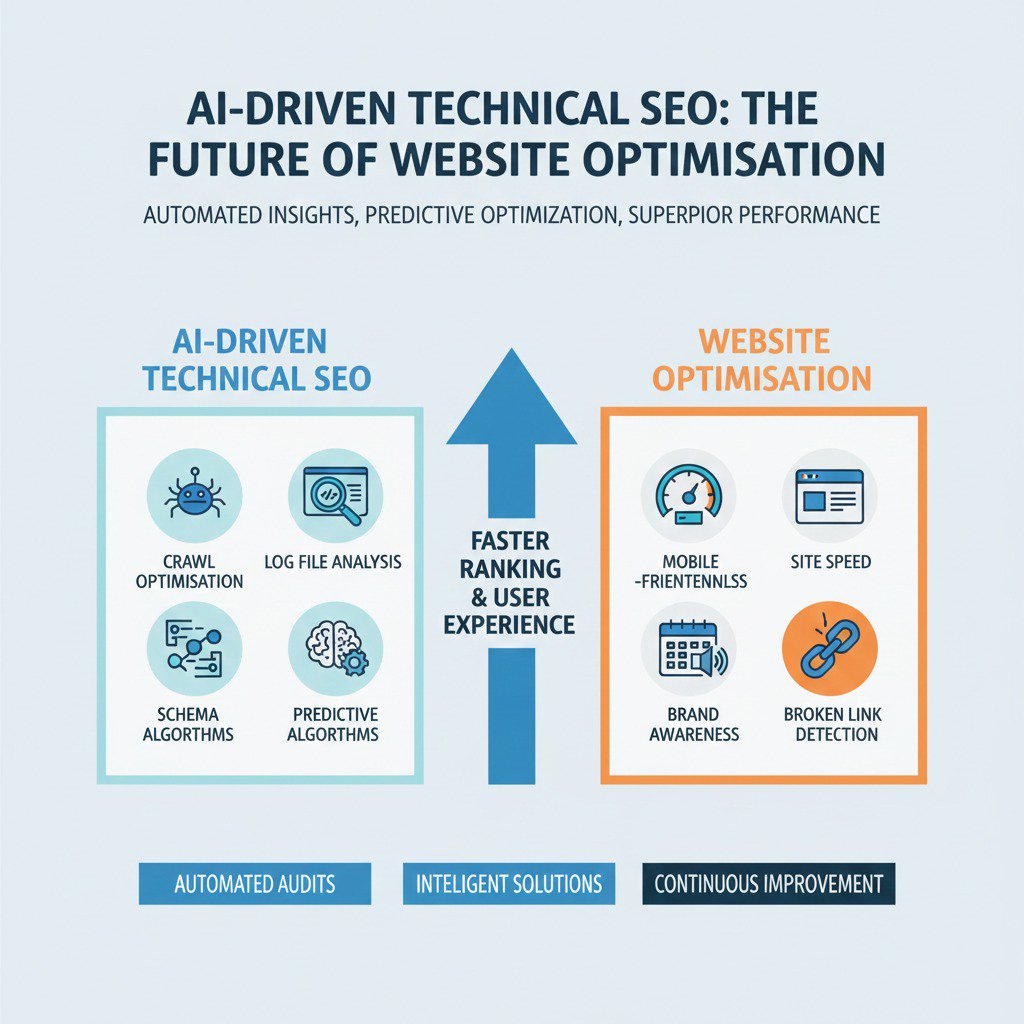
Traditionally, technical SEO has served as the complex & tedious manual foundation of digital performance. Companies have been involved in performing ongoing audits, analyzing log files, and making code-level updates for technical SEO, running in a furious cycle that will often fail due to the fast-paced changes in how search engines function; this is no longer a viable option for businesses to achieve market leadership in this age where companies need access to the power of large-scale LLMs and instant access to vast amounts of processed data.
In response to this rapid evolution, the solution to technical SEO will need to shift to an AI-driven technical SEO.
At Digital Fruits, our vision for the next generation of technical SEO involves not only adding AI tools to your technical SEO but also taking advantage of the power of AI to let it automate & optimize your technical SEO fundamentals, making sure that the key elements that help determine whether or not search engines can crawl, index, and deliver users to your website will be continuously optimized.
With AI-driven technical SEO, we will not only save you from the daily grind of performing technical SEO, but we will also give you access to an ongoing, self-optimizing system, delivering predictable and high organic performance.
The Restrictions of Performing Manual Audits
Conventional technical audits can take an extraordinary amount of time to complete and, therefore, are typically outdated by the time that they are finalized. Furthermore, a conventional technical audit can not keep pace with the previously mentioned speed of technology growth on a website, such as temporary crawl budgets rapidly degrading, very minor core web vitals degradation occurring, and/or canonicals not being properly defined for millions of URLs, creating a very significant technical issue when compared to how many URLs are being impacted.
AI and ML can remove these limitations, and instead of relying on the issues created by technical debt, AI and ML give a web property the opportunity to use this technical advantage. This is accomplished via the following:
- Process enormous amounts of data simultaneously—AI and ML systems can analyze billions of lines of log files, thousands of GSC data points, and hundreds of thousands of third-party metrics in near real-time.
- Identify correlations between technical issues—AI and ML systems can find non-obvious correlations between technical issues, such as slow server time (when compared to regional ranking volatility).
- Assess impact—AI and ML systems are capable of assessing every suggested solution’s potential return on investment, ranking them from highest to lowest potential performance impact.
AI Enhancements of Critical Technical Pillars
When you integrate AI into your previous technical SEO workflow, you are directly making substantial improvements to a majority of the most important elements of website health.
1. Real-Time Core Web Vitals (CWV) Optimization
CWV, or the Core Web Vitals, is comprised of three metrics that define Load Speed (LCP), User Interactivity (FID & INP), and User Experience (CLS). These three metrics are among the three most significant and important ranking factors. An AI platform will continuously monitor and optimize these Core Web Vitals across multiple types of devices and locations in the world.
- Predictive Analysis: An AI system can detect any potential degradation in the CWV’s score prior to adversely impacting the website’s performance. As a result, it will automatically identify issues such as inefficient code and/or images that are under-optimized and are thus likely to occur because of a predicted increase in traffic.
- Automated Fixes: Some AI software will allow for the ability to automatically implement code-level recommendations based on both CWV metric performance and the current state of your CWV performance. The automated implementation of code-level recommendations will ensure that your website is always within Google’s CWV thresholds.
2. Effective and Efficient Crawl Budget Management
For e-commerce and large publishing-type websites using a significant amount of crawl traffic, wasting crawl resources on pages of little to no value to search engines is a huge waste. AI takes the guesswork out of managing crawl budget by:
- Eliminating Crawl Waste: Automatic detection and no-indexing of low engagement pages, thin content pages, and pages with near-duplicates based on criteria applied to all three categories.
- Optimizing Crawl Infrastructure: Continuously changing robots.txt and/or sitemaps based on content decay of high-value content and keyword performance to ensure that the search bot is concentrating their limited resources on your highest-value content.
3. Implementation of Structured Data and Schema
Using schema markup is crucial for search engines to understand the context and entity(ies) of your content. AI automates a very complex process by:
- Schema Generation: It analyzes the content contained in a webpage and automatically produces accurate, quality, structured data (e.g., FAQPage, HowTo, Product) using JSON-LD to maximize the potential of rich results and improve visibility in the search engine results pages.
- Error Validation: It continuously looks for errors or deprecations in structured data to ensure compliance with the constant changes to Google’s structured data guidelines.
Be Proactive, not reactive.
By utilizing AI-driven technical SEO, you move from a strategy of being reactive (fixing things after they break) to being a proactive and predictive strategy. In addition to ensuring that your digital foundation is stable, AI will allow you to continuously adapt to the changing algorithms and take advantage of every nuance of them.
Brands that implement AI into their technical workflow have a significant competitive advantage over brands that do not use AI. They tend to have fewer critical issues, have faster page load times, and can allocate human resources to strategy instead of manual checks. This is how you scale performance in the new age of search.
To take your efficiency and ranking potential to the next level, the first step is to collaborate with a specialist such as Digital Fruits.
FAQs
Q1. What is AI-driven technical SEO?
It is the use of machine learning and AI models to automate, analyze, and optimize website infrastructure, code, and speed factors (like Core Web Vitals) in real-time.
Q2. Why is AI needed for technical SEO?
AI can process massive datasets (log files, GSC reports) instantly and identify complex, high-impact errors on a scale that is impossible for human teams to manage manually.
Q3. Which Core Web Vitals does AI help fix?
AI specifically targets Largest Contentful Paint (LCP—loading speed), First Input Delay/Interaction to Next Paint (FID/INP—interactivity), and Cumulative Layout Shift (CLS—visual stability).
Q4. What is crawl budget management?
It is the process of guiding search engine bots to crawl and index your most important pages first, preventing them from wasting time on low-value, duplicate, or error pages.
Q5. Does AI replace human SEO experts?
No. AI automates the data analysis, monitoring, and error reporting, allowing human SEO experts to focus their time on high-level strategy and creative problem-solving.



Leave a Reply